
- Nov 15, 2019 For any 2014 Mac Mini owners that are not yet convinced that it is worth booting and running off of an external SSD (e.g. Samsung T5), the following Black Magic Speed Tests may help The first 2 are a Late 2014 Mac Mini with an. internal 1TB 5,400rpm spinner. external 1TB Samsung T5 The last 2 are a Late 2018 Mac Mini with an.
- Jan 07, 2016 Mac Mini Late 2014 Hard Drive Replacement - iFixit. And a tool kit I picked up from Amazon: Amazon.com: Mac Mini 2014 (& Newer) Hard Drive Upgrade Tool Kit / Repair Kit Includes TR6 Security Torx, T9 Torx, Logic The process took a little time and patience but it was worth it, and the Mini has been working flawlessly.
- Sep 24, 2018 256GB flash storage (SSD) 512GB flash storage (SSD) 1TB flash storage (SSD) Apple Remote; Mac mini and the Environment. Apple takes a complete product life cycle approach to determining our environmental impact. Mac mini is designed with the following features to reduce its environmental impact: BFR-free; PVC-free 5.
/PowerMyMac /Guide on How to Clone Mac Hard Drive to SSD
When it comes to the cloning topic, what do you expect from the process? If you are planning to clone Mac hard drive to SSD, let us take a close look at what is the cloning process all about. Generally, it is recommended to clone the hard drive of your Mac in case you decide to upgrade the hard drive with a solid state drive (SSD), replace an old or corrupted drive with a new one or if you are going to create a bootable hard drive.
In most cases, all these demands can be achieved with the help of cloning. Essentially, when you clone the hard drive, you will no longer worry about reinstalling the operating system as well as transfer folders, files, applications and some configurations on the new hard disk. Another advantage with the cloning process is that if you have a duplicate hard drive with setup volume, it can aid in booting your Mac easily in case of unexpected disasters.
Article GuideWhat are solid state drives (SSDs)?How to clone Mac hard drive to SSDShould I backup or clone?Let's wrap it up
Upgrading a Non-SSD Late 2014 Mac Mini to Fusion Drive. Today I have a little treat for you and hopefully, it will save you a little money in the process, although to be honest if you bought the Hard Disk version of the Late 2014 Mac Mini, you will probably be thinking that the little powerhouse is not really that great.
What are solid state drives (SSDs)?

Before you decide to clone Mac hard drive to SSD, let us take a close look at SSDs. Solid state drives or SSDs utilize flash memory to keep data. If built into a computer, they are usually seen as chips on the circuit board. You can also find them in 2.5” format that you can install in a laptop or an external enclosure.
Generally, SSDs are quiet, compact and fast, especially if you are starting up a computer or waking up the device. Remember that hard disks might go into sleep mode when not used for a certain span of time and takes a few seconds to spin up. SSDs also utilize less power, run cooler, lighter and do not have any movable parts which make them suitable for laptops.
When you accidentally drop your laptop when the hard drive is spinning, there is a likelihood for the drive to be damaged and lose data. SSDs are generally more dependable, and in case they fail, you can still read data whereas you cannot do this with a hard disk.
Nevertheless, SSDs are considered as a costly option if you are considering the cost to storage ratio. At present, you can purchase an 8TB external drive for less than $150 while that same amount of money will only provide you with a 500GB SSD.
People Also Read:How to Partition A Hard Drive on Mac?How to upgrade your MacBook Pro with an SSD?
How to clone Mac hard drive to SSD
There are several reasons why it is best to boot from an external hard drive. In case you prefer to keep your files synchronized from a desktop and laptop, enlarge your storage or have an on-hand bootable backup duplicate of your system, there is an unseen feature in Disk Utility that makes the process an easy task.
Essentially, booting from an external hard drive is usually slower, even if you are using the latest Thunderbolt or the USB-C drives. They are relatively sluggish than the solid state drives (SSDs) that are found in most of the latest Macs. Although this is not suggested for daily use, it is a possible option.
Using Disk Utility
If you are going to clone Mac hard drive to SSD, it is recommended to use Disk Utility.Simply open Disk Utility from the Spotlight (Command+Space) or on the Utility folder in your applications. You will be presented with a list of all the volumes including the internal hard drive and the external hard drive.
It is important to note that the “Restore” option in Disk Utility will work by copying the files from the backup to your core drive. It is ideally intended to the utilized for Recovery mode to reinstate the hard drive in case a failure occurs.
Once you decide to set your external drive as the restore target, you can switch that action around and copy files from the main drive to the backup. Choose your external drive in the sidebar, tap on the “Restore” button in the menu and select your main drive as the “Restore From” option. You have the option to choose an ISO image, but it does not have much use.
Tap on the “Restore” button and Disk Utility will initiate the copying process. In most cases, the process is relatively a long one which is based on the speediness of your external drive as well as its link to your Mac. Due to this, it is recommended to have a rapid hard drive with USB-C, Thunderbolt or USB 3.0 connections.
Once Disk Utility completes the task, you can turn off your Mac and press on the Option when it starts to restart again. You will be presented with the boot switcher and you are allowed to boot from the external hard drive. You can utilize your Mac as usual but remember that it is separate from the installation on the main internal hard drive. Take note that any settings that you alter or files that are saved there will not be reflected on the primary installation.
You can perform the same process in a reverse manner if there is a need to copy the files back over or to restore the backup in case your computer malfunctions.
Should I backup or clone?
Generally, hard disks can be backed up or cloned. Remember that there are differences between the two with their own advantages and drawbacks.
Backing up a hard drive
If you are going to back up a hard drive, the entire content of the chosen drive or partition is backed up into a file on the targeted location. All data is saved into a single file. When a complete backup of the hard drive is carried out, the whole operating system along with the installed applications and settings are also set aside. The file can be protected or encrypted with a password.
The advantage of this approach is no other than simple management since a single file contains the whole backup. You can also compress the backup file so that it utilizes less space.
As for a drawback, you need a backup software to be able to reinstate the system or data to a previous state or to access documents and files.
Cloning the hard drive
If you are going to duplicate or clone Mac hard drive to SSD, a copy of the drive is created directly on the target location. This simply means that you have an instant copy including the hard disk structure. A cloned disk or drive includes all the partitions from the source drive or disk.
An advantage with cloning is that the data is directly copied to the specified location and can be utilized and edited directly. The duplicated system drive which includes the operating system can be mounted as a fresh drive and booted right away.
As for the drawbacks, a clone requires more space since the partitions are created immediately on the targeted disk. Due to this, it is not likely to compress or add encryption to the data.
Let's wrap it up
If there is a need for a backup to be created regularly, it is recommended to opt for the hard drive backup. This usually takes up less space and allows the creation of extra backups.

In case you require a bootable extra drive to be operational after an unforeseen crash and to lessen the downtime period, it is best to clone Mac hard drive to SSD.
Generally, both methods have been proven to be the ideal choice. A consistent drive backup for daily data along with a clone of the system drive is essential for easy accessibility in case of emergencies.
ExcellentThanks for your rating.
Rating: 4.6 / 5 (based on 84 ratings)
People Also Read:
PowerMyMac
A powerful all-in-one App for Mac
Free Download
The most powerful and useful 16-in-1 Mac Software in 2019
Free DownloadI finally got around to upgrading my 2014 Mac mini with a solid state drive (SSD). The difference is like night and day. If you’re using one of these models and you’re looking for a good way to bump up the performance, an SSD is, quite frankly, one of the only things you can do (unlike older Mac minis, Apple soldered the RAM in place). Regardless, I strongly recommend considering it – not just for a 2014 Mac mini, but for any older Mac you’d like to pep up.
At $499, the base-model Mac mini is Apple’s least-expensive Mac, half the price of the MacBook Air but not nearly as peppy. It comes with a 1.4 GHz CPU and 4 GB of RAM. I never expected it to win any races, but what kills the Mac mini compared to the MacBook Air isn’t the CPU or the RAM. It’s the storage. That’s because Apple continues to offer that model with a spinning hard disk drive, and that murders performance.
The price of SSDs has dropped precipitously in the past few years, but hard drives remain the champion of low cost per gigabyte – a 500 GB HDD replacement for a Mac mini costs you less than $50 at retail, while a 500 GB SSD might cost three times that amount. It’s little wonder that Apple continues to use them for low-cost, low-margin systems like the Mac mini. In the process, Apple sacrifices a lot of performance.
21st-century computing saddled with 20th-century storage
Ssd Upgrade For Mac Mini 2014 Price
Hard drives are faster, smaller, and use less energy than ever before, but they’re still essentially unchanged in basic concept from the first refrigerator-sized storage devices that IBM developed for its room-sized computers more than half a century ago.
Almost 30 years ago I worked for a hard drive company, and one of the first things I did when I started was to take apart a drive to understand how it worked. The one I disassembled was bigger, slower, noisier, and less reliable than the ones used in computers today, but with the cover off, it looked just the same as a modern one. Different materials, upgrades in mechanisms and capabilities, much better electronics inside, but mechanically similar enough that there’s no mistaking it.
Inside each hard drive is a mechanism that looks remarkably like a record player. Your data is written to a disc of magnetic material that spins on a central motor. A tiny arm outfitted with sensitive electronics reads and writes data sequentially to the disc surface by changing microscopic parts of the surface’s magnetic polarity.
Why SSDs make the difference
macOS is not bad at navigating slower-speed CPUs and limited RAM overhead. It does so by pushing off a lot of work to “virtual memory,” which pages information out to storage when not in active physical memory. That’s why my poor Mac mini slowed to a crawl whenever I asked it to do something. Click on an app icon in the Dock, for example, and I’d lose track of how many “bounces” I’d watch until it finally opened. Trying to do anything was equally painful – lots of spinning beach balls while the Mac waited for data. Starting up and shutting down took a long time too, as macOS handled all that virtual memory housekeeping.
Using a Mac with limited memory, slow CPU and a spinning hard drive requires infinite patience. More often than not, I’d start to do something, wander off until the Mac mini was ready, then get back to it.
SSDs comprise memory chips with no moving parts. They’re very sophisticated memory chips, connected to equally complex controller circuits which manage the flow of data hither and yon. But they’re not saddled with spinning motors, disk arms, or anything else that moves. The flow of data is governed by basic physics – how fast electricity moves across circuits, the bandwidth of the controller chips and the peripheral interface.
As a result, SSDs are very fast. They’re also very quiet, since there are no moving parts. They’re more reliable than hard drives too, since jostling them doesn’t risk damaging moving components inside. They can also be produced in much smaller sizes, though SSD makers also make them in housing designed to work as a plug-and-play Serial ATA (SATA)-equipped replacements for hard drives. I used one such drive, from Mac-friendly upgrade company Other World Computing.
Replacing the hard drive with an SSD removes that bottleneck. Now the Mac mini performs more like a MacBook Air (albeit still slower than one). Two or three bounces and apps open. I can open several apps at once without suffering the indignity of endless beach balls. It’s really brightened things up. I haven’t benchmarked it, but I really don’t need to – it was totally worth the effort.
Doing the upgrade
This is now the fourth Mac mini model I’ve worked on, and Apple has changed them each time. Sometimes the changes were subtle, sometimes dramatic. This was by far the most challenging Mac mini I’ve disassembled. But in the end, it went smoothly and without incident. I’m not going to go through the process step-by-step, but I thought I’d offer a few impressions and suggestions based on my experience. If you’re interested, just Google it or hit YouTube for help. iFixit’s step-by-step teardowns and repair guides are indispensable. (I found the Verge’s teardown instructions, written by Nick Statt, which I won’t link to here, to be needlessly hysterical and overdramatic.)
The first order of business was to clone the Mac mini’s hard drive to the SSD. I did so by putting the SSD in an external USB drive sled I keep around for such occasions – they’re a dime a dozen from vendors like NewEgg. This wasn’t strictly necessary – I could have used the Mac mini’s Internet Restore mode to download a fresh copy of macOS from Apple’s servers and install it, then restore from my Time Machine backup. But I wanted to save myself time. Cloning creates a bootable bit-for-bit copy of the existing hard drive. I used Shirt Pocket’s SuperDuper to handle that.
The first thing that tripped me up when I popped off the Mac mini’s bottom case cover: The 2014 model uses T6 security screws on the bottom. T6 security screws differ from standard Torx screws with an indentation in their center that keeps a regular Torx bit from fitting. You’ll need a special T6 security bit to remove it. Again, iFixit saved my bacon here – their toolkit included everything I needed, except for a motherboard removal tool (read on for details).
Here’s a tip: As you’re going along, use your smartphone to take photos of all the screws you remove, or place them on a mat in roughly the same place as you took them out. That’ll make it easier for you during the reassembly to figure out which screws go where.
Ssd Upgrade For Mac Mini 2014
To replace the hard drive on a 2014 Mac mini, you have to disassemble the Mac mini case, carefully disconnect the Wi-Fi antenna, disassemble the fan, remove the main logic board and the power supply. Most of that is pretty straightforward, albeit time consuming, often frustrating work because of the small space and tiny components. I budged an entire morning to do the upgrade, but I was doing a lot of other stuff while I worked.
Most of the guides I saw mention a Mac mini motherboard removal tool, which is inserted into two holes on the motherboard to help you slide it out of the back of the case. iFixit offers their own version for $5, and I’ve seen videos of people improvising their own using a pair of small screwdrivers or even using a straightened wire coathanger. It was unnecessary in my experience – just pushing the board out the back with my thumbs was enough to get it out. But forewarned is forearmed. If you want to make sure you have everything you need, make sure to have that on-hand too.
Once those items are removed, the last thing to do is to remove the hard drive tray. Four screws on either side of the drive hold it in place, and the SATA data cable is glued down to the drive’s controller board and affixed using a small piece of black tape which keeps the SATA cable in place. Both the tape and the SATA cable can be peeled off and put back in place once you’ve replaced the drive with the SSD. One last note – the hard drive Apple included in my Mac mini had two little foam pieces glued to it to reduce drive vibration. I didn’t bother to put those back on the SSD, since SSDs don’t vibrate, and because the SSD I used was taller than the 7mm drive, manufactured by HGST, that Apple installed. I haven’t seen any negative results.
Following the steps in reverse order I was able to close up the Mac mini and get it started without any issues. It booted right up and has been operating fine ever since.
In conclusion
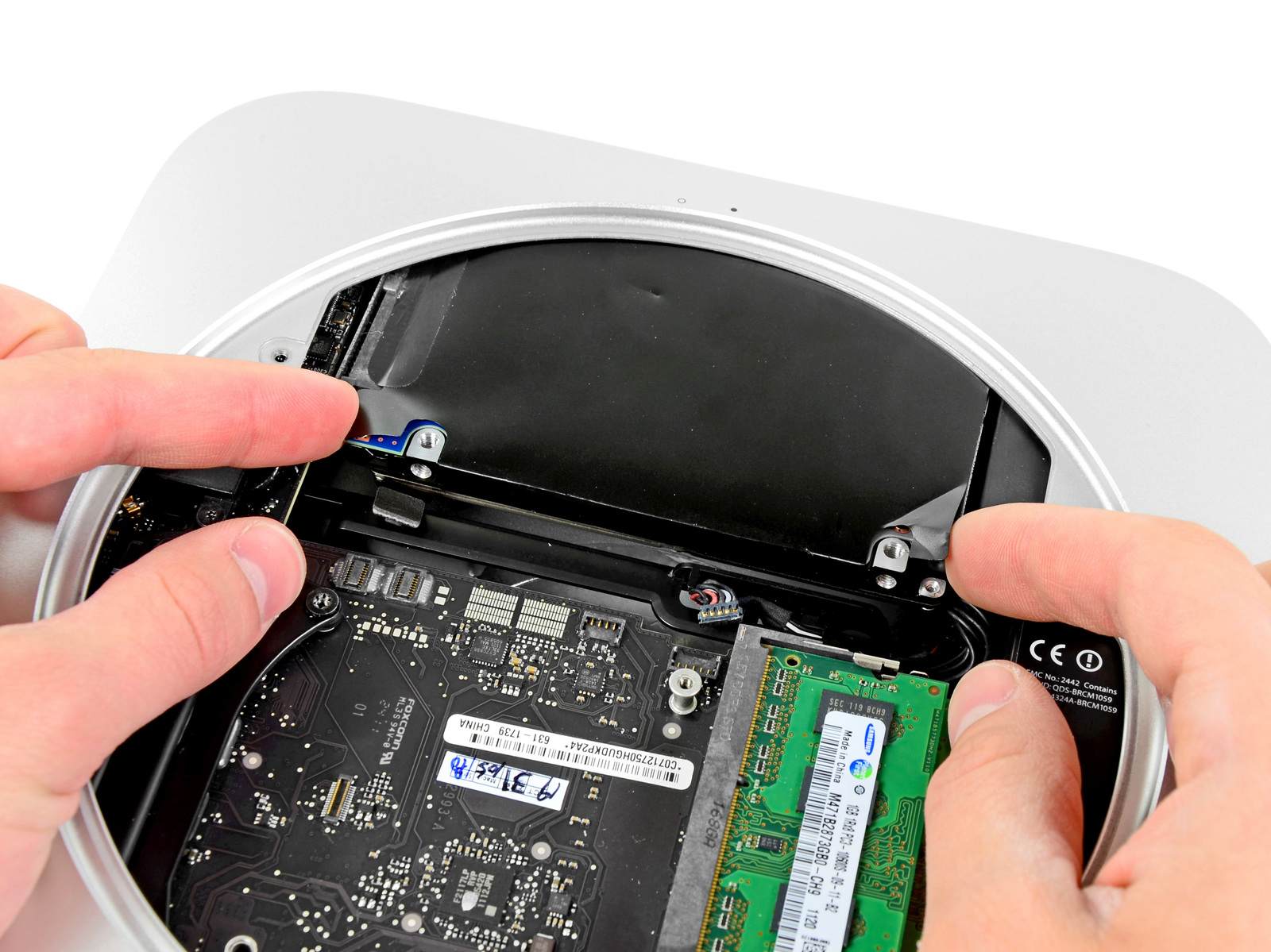
This isn’t an upgrade for the faint-hearted, and I really wouldn’t recommend it for a first-time either. But if you have some experiencing taking Apple gear apart, or even if you just have the will to do it, it’s well worth the time. Set aside a few hours to do and make sure you have the right parts – get familiar with some online tutorials, then get cracking!
SaveSave
SaveSave
SaveSave